ADHD Resistance to Unexpected Schedule Changes
Why unexpected schedule changes trigger intense reactions in ADHD brains.
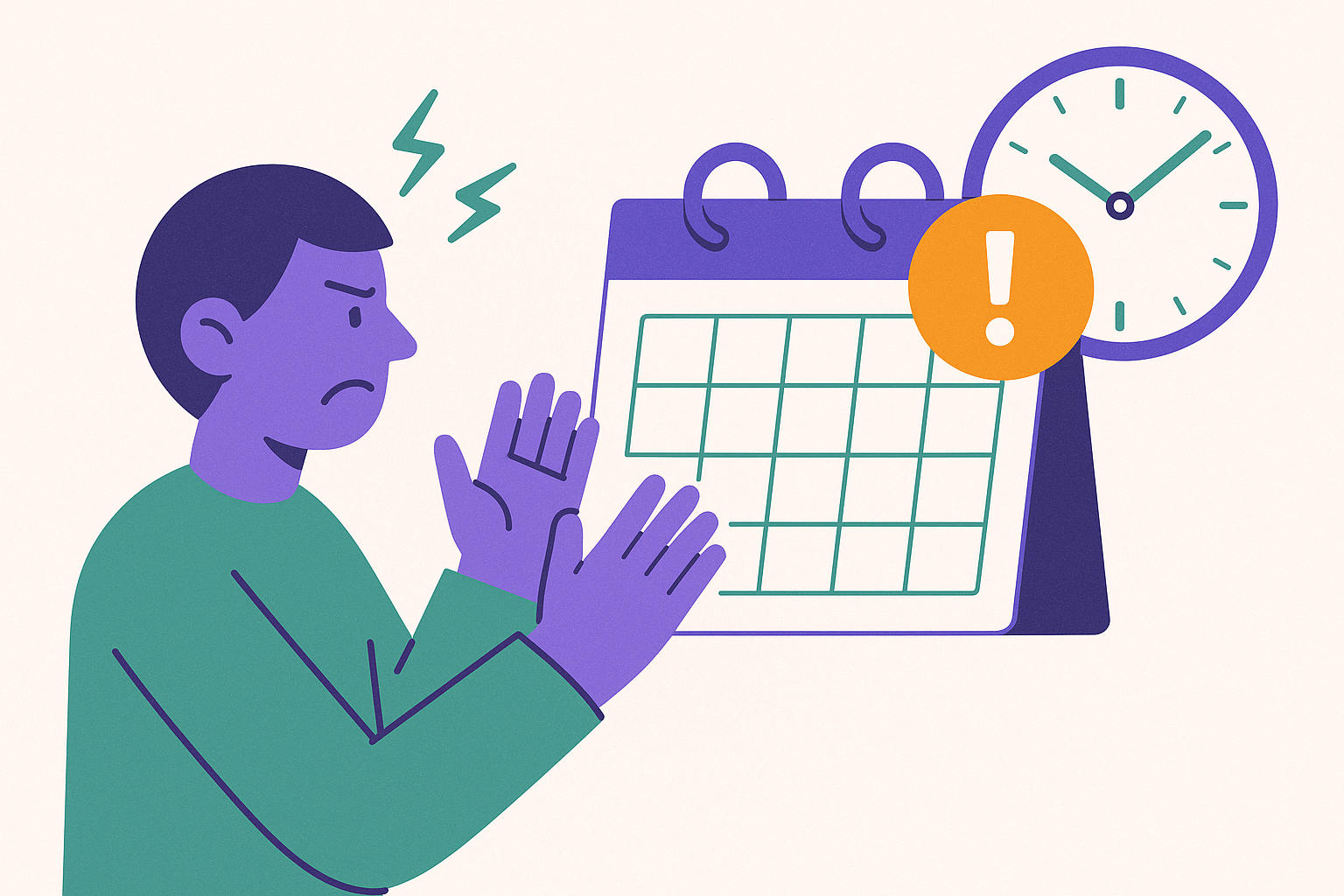
My kid missed a bus transfer once by four minutes and cried for forty. It wasn't really about the bus. His whole afternoon had a shape in his head, and that shape was gone. I used to think that was an overreaction. Now I think it was just biology, doing exactly what biology does when the plan changes and nobody warned it first.
What a transition actually asks of the brain
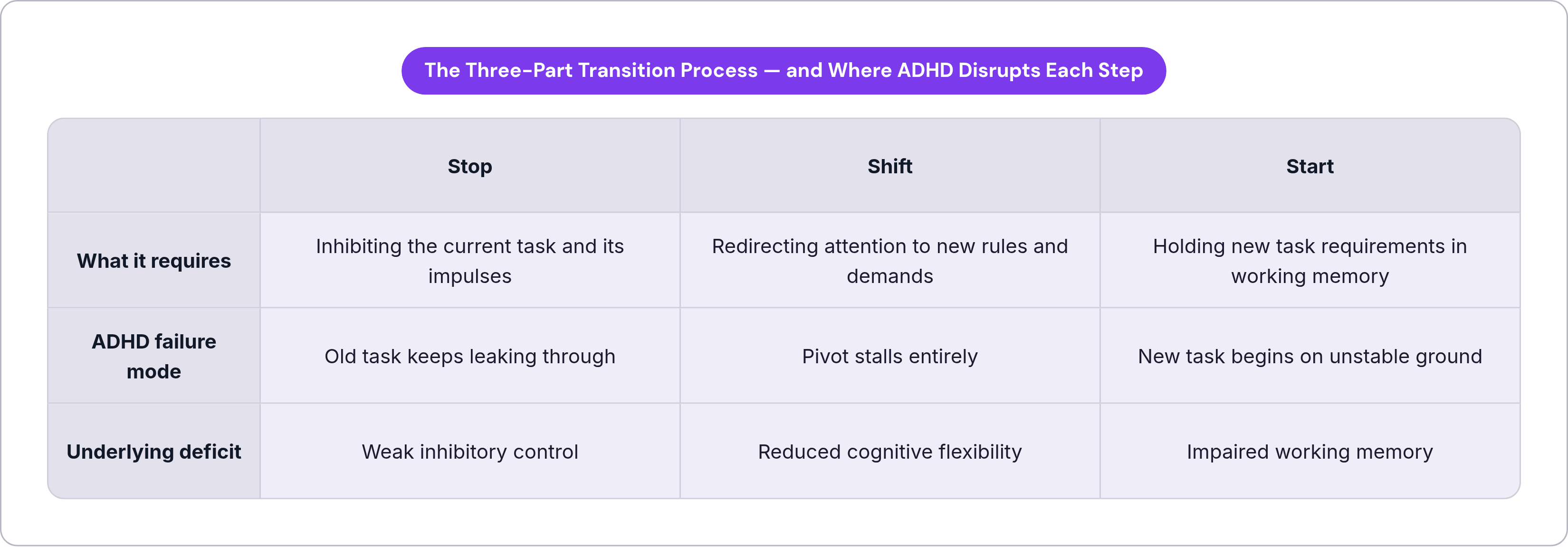
A transition feels like a single move, but underneath it's three jobs, stacked one on top of the other, and every one of them has to fire in order or the whole thing wobbles.
First you stop. That means shutting down the current task and every impulse still attached to it, which is harder than it sounds when the task was interesting. Second you shift, dragging your attention over to a new set of rules, a new frame, a new demand. Third you start, and starting means holding the new task's requirements in working memory while the last task is still fading out, like a radio station bleeding through on a frequency you've already changed.
Barkley's work on this is pretty blunt about it: inhibitory control, cognitive flexibility, working memory, all three run less efficiently in the ADHD brain. So "hey, can we push this to 3pm" is a three-part cognitive operation dressed up as a five-word request, and if any one part misfires, you feel it. Skip the inhibition step and the old task keeps leaking through. Skip flexibility and the pivot just stalls. Skip working memory, and the new task starts on ground that's already shaking.
How the prefrontal cortex and dopamine system make transitions harder in ADHD
All three of those jobs live in the prefrontal cortex, and the prefrontal cortex is exactly where ADHD shows up most consistently in the research. That's not a coincidence, either. It's one region of the brain doing three jobs at once with less fuel than it needs.
Flexibility takes the worst hit. A 2023 network analysis of cognitive testing in ADHD adults put flexibility right in the center, tightly wired to processing speed and mental fluency, a hub that drags everything else down when it slows. A meta-analysis of 83 studies found consistent impairments in set-shifting, the technical term for swapping one mental rule for another, across people with ADHD.
Then dopamine. The mesolimbic pathway runs on motivation and reward; interesting tasks push dopamine up, boring ones don't. So walking away from something engaging to do something duller isn't just annoying, it's a chemical drop. Research has found a real biochemical basis for why switching away from something stimulating feels like such a loss.
And under both of those sits time blindness. Barkley draws a line between retrospective time sense, looking back at how long something took, and prospective time sense, guessing how long something will take before it happens. ADHD brains are worse at the second kind, by a lot, which means a person often can't tell you how long a task will run or what it'll cost to leave it early. The regions doing that clock work, the neocerebellum, the basal ganglia, the prefrontal cortex, are the same ones lighting up in ADHD scans generally. No internal clock means a schedule change never really arrives on time; it just happens.
The switch cost, and why it is amplified in ADHD
There's a term for the mental residue left behind after you've technically moved on: switch cost. Everybody pays it, and most people pay it and forget they paid it, because it clears in a second or two and life moves on.
In ADHD, that residue sticks around. Studies keep finding bigger switch costs, with the old task-set proving stubborn in a way that doesn't seem to budge much with effort alone.
Hyperfocus doesn't help, and honestly it makes the bill worse. Flow is engagement you can step out of when you choose to; perseveration is engagement you can't stop even when you want to. Research suggests ADHD hyperfocus leans toward the second kind more often than people assume. The deeper you sink into it, the bigger the switch cost on the way out, and ADHD brains sink into these states more often to start with. It's a bad combination.
Unexpected changes hit hardest of all, because there's no ramp. A planned transition lets the cost bleed out slowly over the minutes leading up to it. An unannounced one lands in one shot, full weight. Same person, same shift, wildly different outcome, depending entirely on whether they saw it coming.
The emotional reaction that follows — and why it is not optional
Emotion regulation and executive function share plumbing, and when one backs up, the other floods.
Shaw's research, published in the American Journal of Psychiatry, puts the number at somewhere between 30% and 70% of ADHD adults showing real emotion dysregulation, with kids landing at 25% to 45%. Wide range, sure, but even the low end is enormous. Adults with ADHD also tend to lean on regulation strategies that don't work especially well, and the worse the executive function struggles, the worse the emotional fallout tends to run.
Stack that onto an unexpected schedule change and the math turns ugly fast. Cognitive load and emotional load don't sit next to each other quietly, they compound. Each forced switch across a day costs a little more than the last one did, until frustration and guilt are piled three deep by evening. In kids this can look like a meltdown, or a flat refusal, or anxiety spiking out of nowhere, and adults around them read it as defiance when it's closer to a system that's simply out of runway.
Rigid thinking in that moment isn't really a choice, either. Coming up with alternatives, weighing them, picking one, all of that runs on flexibility, and flexibility is the exact resource that's already spent. Worth saying plainly: that reaction is a system doing what a taxed system does, not a character flaw showing itself.
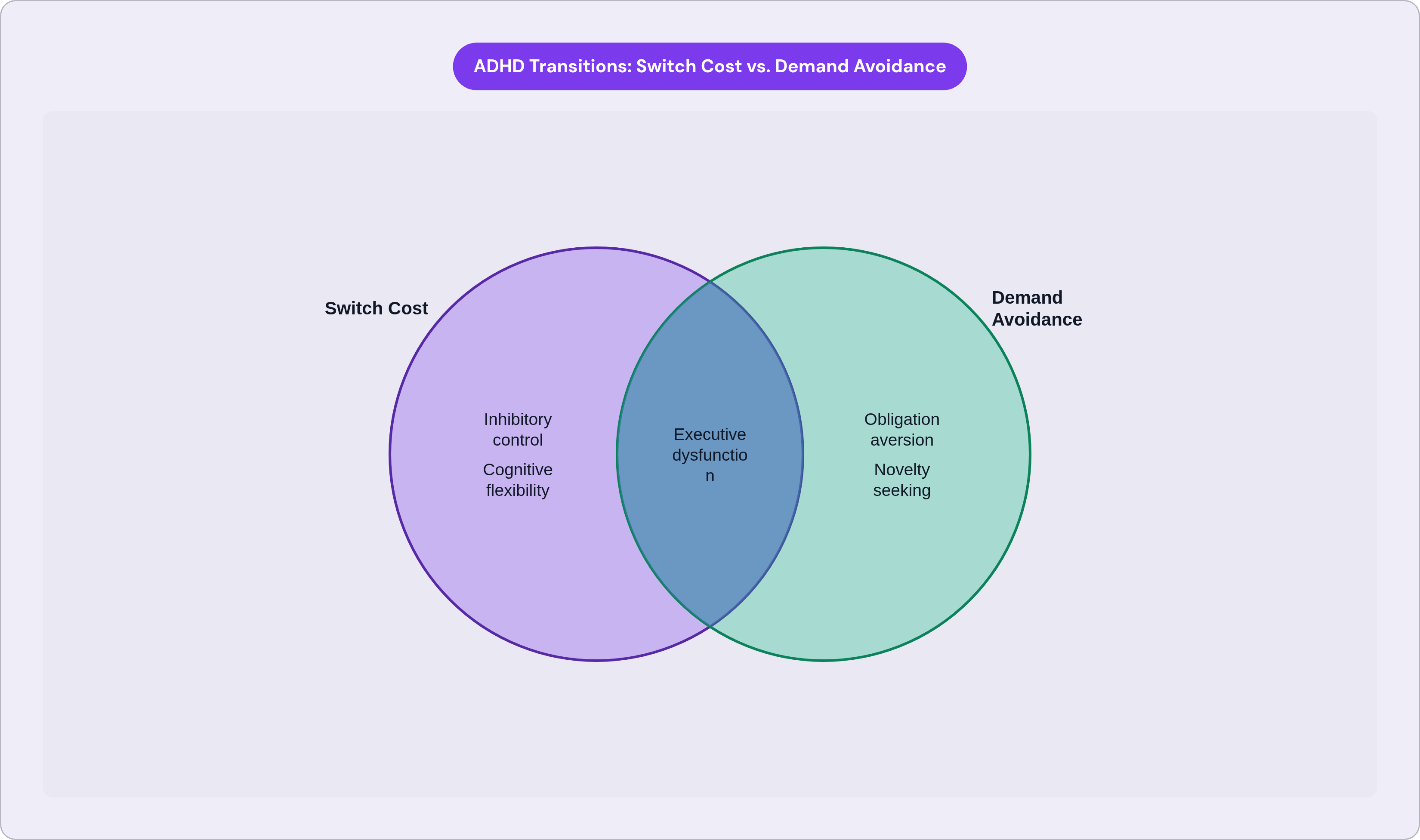
When avoidance enters the picture — demand avoidance as a related but distinct pattern
Demand avoidance is a different animal, though it grows out of the same soil. It's a strong pull away from tasks and obligations, and strangely, the pull often gets stronger exactly when the task matters more.
It shares the same root cause as everything above: executive dysfunction, emotional dysregulation. Pathological Demand Avoidance, or PDA, isn't in the DSM-5 as its own diagnosis, but it shows up next to ADHD often enough that ignoring it doesn't make sense. Parents and managers alike tend to read it as defiance, when what's actually driving the car is anxiety.
Here's the part that trips people up: the ADHD brain genuinely craves predictability. Routine cuts cognitive load and gives a transition something solid to grab onto. But the second that routine turns into an obligation, the second it becomes something you have to do rather than something you get to do, it can start tripping the same avoidance wiring as any outside demand. Novelty is what spikes dopamine, and routine stops paying that dividend after a while. So the structure that was supposed to be a life raft quietly turns into one more thing to dodge.
Unexpected schedule changes sit right where both problems meet. They force a transition, which means switch cost, and they arrive as an unwanted demand, which trips avoidance. Two separate mechanisms, landing at the same moment, on the same person.
What this costs at work — the scale of disruption in professional settings
This isn't a niche concern tucked away in a support group somewhere. The CDC's 2023 numbers put adult ADHD at roughly 15.5 million people in the U.S., about 6% of adults.
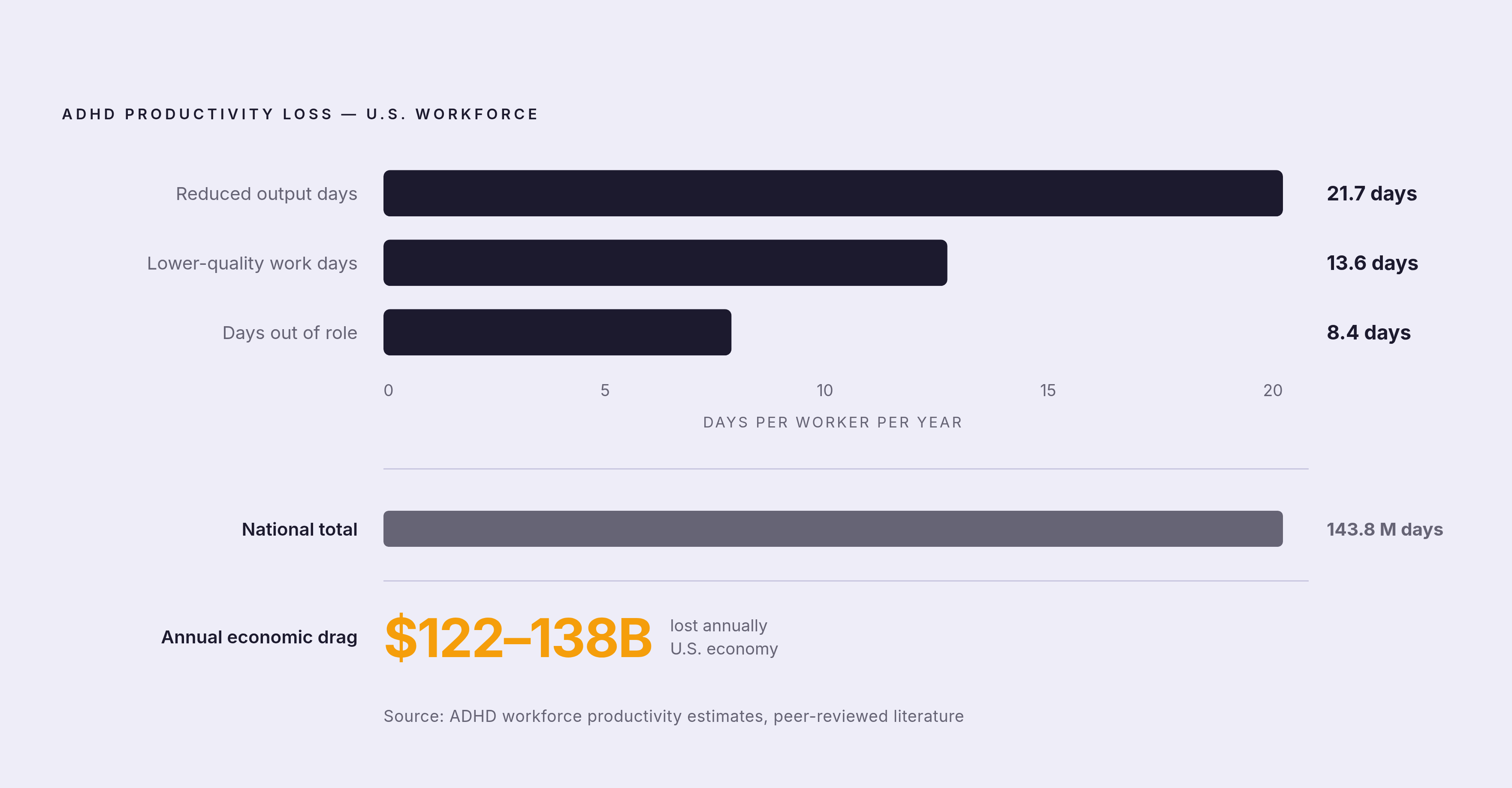
The productivity data makes the cost concrete. Workers with ADHD average 8.4 excess days out of role a year, 21.7 days of reduced output, 13.6 days of lower-quality work, adding up to something like 143.8 million lost productivity days across the U.S. workforce annually. The WHO's World Mental Health Survey found adults with ADHD missing about 22 workdays a year on average. Biederman and Faraone's work out of Harvard found an income gap of $10,791 a year, and adults with ADHD are three times as likely to lose a job. Total drag on the U.S. economy lands somewhere between $122 and $138 billion annually, depending on whose model you're reading.
Schedule disruption specifically drives a good chunk of this. Research has found that poor time management and disorganization are the actual bridge between ADHD and burnout: time management problems lead to physical exhaustion, organizational problems lead to emotional exhaustion. Research has found that live meetings can cause significant disrupted work time for ADHD adults, given the forced context switching involved. The meeting itself, just sitting through it, is a forced context switch that costs almost as much as the meeting's own length.
Employers haven't caught up to any of this. One survey found only a minority of U.S. employers offer formal ADHD accommodations, trailing well behind the rates for dyslexia and autism. Part of that gap is probably that the accommodations which actually help, written summaries instead of live readouts, async updates, protected blocks of deep-work time, are process changes rather than a line item you can buy. Process changes are harder to standardize than a software license, and harder still to put in a policy document that HR can point to.
Strategies that work with the neurology, not against it
The goal is lowering the price of the transition so the brain doesn't have to fight its own wiring every single time.
Advance warning does more than it looks like it should. A heads-up gives the brain a runway to start winding down the current task before the switch gets forced on it, and that runway cuts directly into switch cost. Vague warnings barely help though; "we're leaving in ten minutes" beats "we'll head out soon" because the ADHD brain can't reliably track elapsed time on its own; it needs the anchor spelled out.
Externalizing time and structure works for the same reason. Visual timers, written schedules, routines that repeat enough to become automatic: all of it compensates for the prospective time problem Barkley's research keeps circling back to. When the scaffolding is visible, a surprise doesn't hit as hard, because less of the load is riding on an internal clock that was never that reliable to begin with.
Small rituals between tasks matter more than they get credit for. A short walk between meetings, a quick note scribbled down on where an interrupted task stands: something brief and repeatable, so the old task-set has somewhere to land instead of bleeding into whatever's next.
Protecting stretches of deep-work time cuts the total bill down, not just the cost of any one switch. Batch the meetings, trim the interruptions, lean on async tools where they make sense, because fewer forced switches across a day means less cost piling up by 5pm. There's also a growing set of AI tools built to hold onto context between tasks and summarize where something was left off, which cuts down the re-orientation tax of picking a thread back up. Tools like these aim to shave off some of that overhead, though the judgment calls in the moment are still yours to make.
The emotional side needs its own plan, separate from the scheduling fixes. With somewhere between 30% and 70% of ADHD adults dealing with real emotion dysregulation, strategies have to cover the aftermath too: naming the reaction for what it is, building in actual time to recover, not letting shame stack on top of a moment that was already hard enough. And where anxiety, sensory sensitivity, or an autism-linked need for sameness overlaps with ADHD, the accommodations need to stretch to cover that too, not just the executive function piece.
What changes when you understand the mechanism rather than the behavior
Read it as stubbornness and the instinct is pressure: more criticism, tighter deadlines, an ultimatum. All of that just piles more weight onto a system that's already at capacity.
Read it as neurology and the instinct changes entirely: warning, structure, protected time, an honest read of what's actually happening. Same moment, opposite response.
My kid still hates surprise schedule changes. That hasn't gone away, and I don't think it's supposed to. What's changed is that I text him "leaving in ten minutes" now instead of just grabbing his shoes, and most days that's enough. Not always, but most days.
The resistance was never really about the bus.