Sensory Overload and Cognitive Performance in Open-Plan Work Environments
Brain scans reveal why open offices drain mental resources faster than enclosed workspaces.
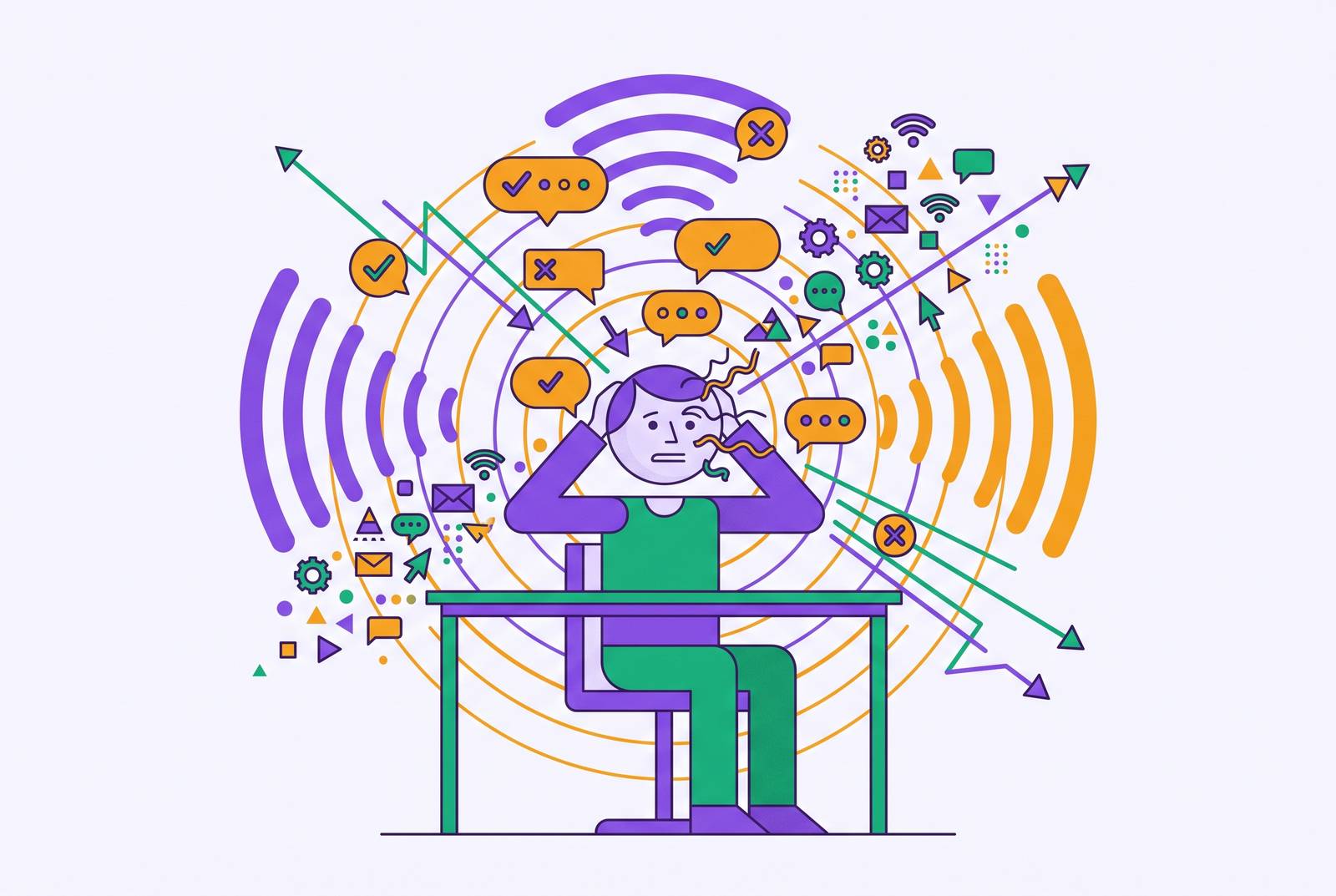
Open-plan offices ask the brain to process more input than it can actually filter, and that gap between what comes in and what gets used is where the real damage happens. Sensory overload isn't a feeling of being frazzled. It's a measurable drop in the cognitive resources a person has left to spend on the task in front of them. Attention works like a gate: the prefrontal cortex decides what gets through, dopamine reinforces the stuff tied to a goal, and both systems run on a limited supply. Psychiatrist Edward Hallowell said no brain in history has been asked to track this many data points at once, and Steelcase's research backs him up on why smart, capable people underperform once they're sitting in the middle of it. Everyone has a threshold before their nervous system reacts, but that threshold isn't the same for everyone. Some people hit overload at a noise or clutter level that a coworker two desks over doesn't even register, and one study monitored 26 participants via EEG completing simulated office tasks (email, notification monitoring, word recall) in two conditions (an open-plan workspace with colleagues nearby vs. a small enclosed work pod with glazed panels. It's wiring. It's wiring, and it means the open-plan floor plan isn't a mild inconvenience so much as a constant draw on the exact mental machinery that knowledge work runs on. This section keeps the framing conceptual and brief, setting up the EEG evidence and productivity data that follow.
Open-plan layout spread and its impact on workers
Roughly 70% of U.S. office workers sit in some open-plan arrangement, which means it is the default. A 2013 analysis covering more than 42,000 workers across the U.S., Finland, Canada, and Australia found something that should have stopped the trend cold: people in open layouts were less satisfied with their workspace than people in private offices, and the reason wasn't taste, it was uncontrollable noise and a lack of privacy Open-Plan Offices Could Be Hurting Employees’ Brains, New Research Su…. A 2019 Leesman survey of 740,000 employees found only 57% said their workplace actually supported focused work, meaning nearly half the workforce sits somewhere that fights against the thing they're paid to do.
Return-to-office mandates made this worse in a way that's easy to miss. Remote work gave people years of near-total control over their own sensory environment: their lighting, their noise floor, the timing of interruptions. Walking back into an open floor after that stretch isn't returning to a familiar baseline. It's re-encountering an old environment with none of the self-regulation habits that made it tolerable the first time. Offices have physically shrunk since the pandemic too, so on the days everyone's required in, the same square footage holds more people, which makes the acoustic and visual load denser than it used to be. A quiet misconception drives all of this and produces the belief: "I handled it before, so I should handle it now."" Tolerance isn't fixed. It moves with sleep, stress, and how much a person has been leaning on outside supports to cope.
EEG data from a 2026 study showing what happens inside the brain during open-plan work
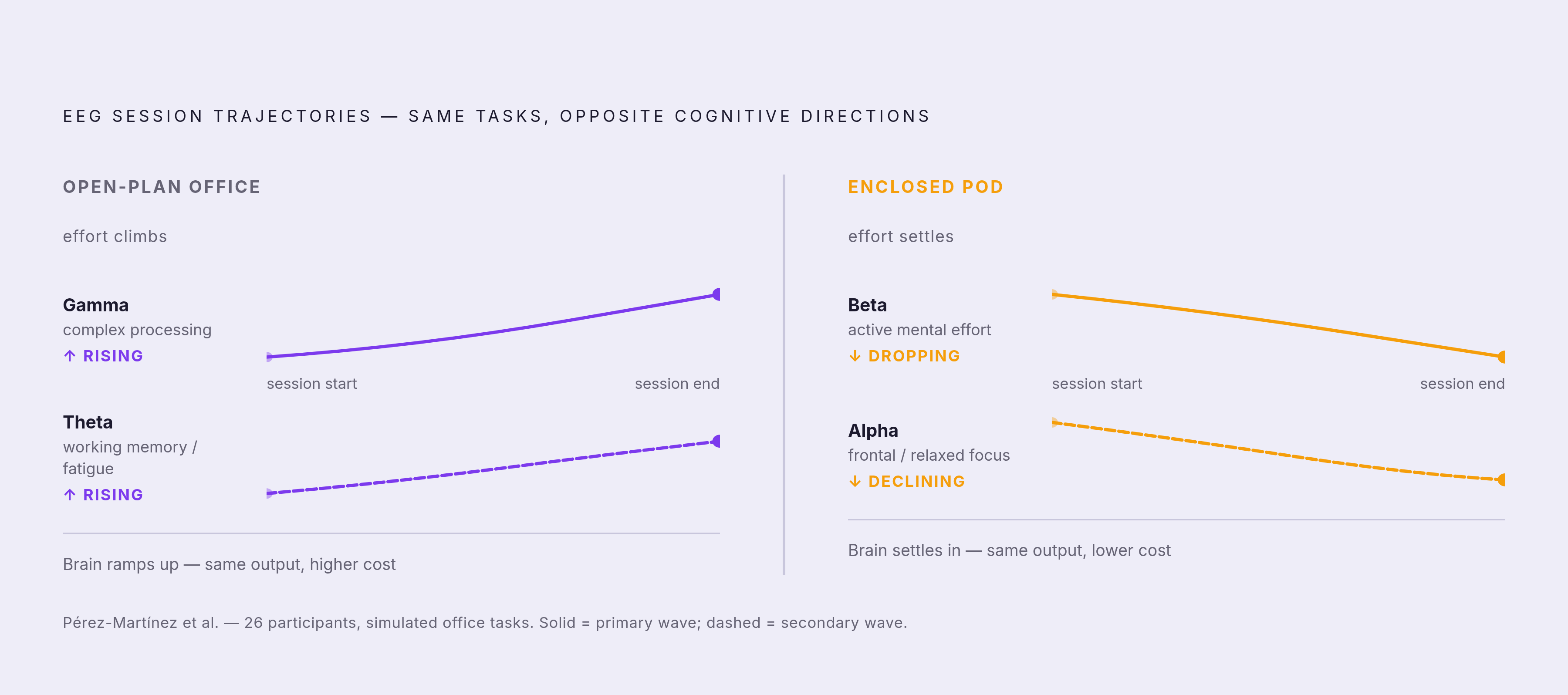
A study out of the Universitat Politècnica de València, led by Pérez-Martínez and colleagues, put hard numbers behind what workers have been saying for years. Researchers fitted 26 participants with EEG headsets and had them run through simulated office tasks, email, notification monitoring, word recall, under two conditions: an open-plan setup with colleagues nearby, and a small enclosed pod with glazed panels.
In the open-plan condition, gamma waves, the signature of complex mental processing, climbed steadily as the session went on. Theta waves, tied to working memory and mental fatigue, rose too. Arousal and engagement both went up, which sounds like a good thing until you realize what it actually means: the brain was working harder just to hold steady, not to produce more.
In the pod, the pattern flipped. Beta waves, the marker of active mental effort, dropped off over the session. Alpha waves and overall frontal activity declined as well. Translation: the brain needed less effort over time to do the same task. It was settling in, not ramping up.
Same people, same tasks, opposite trajectories. That contrast is the whole finding. The environment, not the work itself, set the cognitive price tag. Environmental Load Theory has argued for years that once stimuli exceed attentional capacity, overload follows; this EEG data gives that theory a physical signature instead of just a survey result.
The irrelevant speech effect: why speech noise is the most disruptive channel
Ask why speech is worse than almost any other office noise, and the answer is something called the irrelevant speech effect. When intelligible speech reaches the ear, the brain processes the language whether a person wants it to or not. It slides straight into working memory, uninvited.
That matters because working memory is the bottleneck for most knowledge work: reading comprehension, mental math, drafting a sentence, proofreading a paragraph. Speech competes directly with all of it. Laboratory studies have documented productivity losses from speech noise as high as 41% USPTO patent document. A 2025 study in Noise & Vibration Worldwide ran 25 participants through 50-minute simulated scenarios and found real differences in reaction time on standard cognitive tests; people higher in neuroticism showed steeper reaction-time degradation, with correlations of 0.410 and 0.423. Both tonal noise and background speech hurt performance, but not identically for everyone. Task complexity, how familiar the language is, and a person's individual noise sensitivity all shift how much damage gets done, which matters later when the conversation turns to who bears the biggest cost.
So why don't noise-canceling headphones just solve this? Because they only shut down one channel. Visual movement, unpredictable interruptions, lighting, temperature, and the sense of being watched all keep running underneath, untouched. In a study published in the Journal of Environmental Psychology, 47 participants working in simulated open-plan office conditions remembered fewer words, rated themselves more tired, and reported lower motivation at high noise (51 dB) compared to low noise (39 dB).
Visual clutter and movement as a parallel cognitive tax that most offices ignore
Sound gets most of the attention in office design conversations, but sight is doing its own quiet damage. Research out of the Princeton University Neuroscience Institute found that clutter in the visual field makes it harder to concentrate on one task, because multiple stimuli end up competing for the same neural real estate. In an open-plan office, that clutter is dynamic. It's colleagues walking past, overlapping screens, unpredictable flickers of motion at the edge of vision, and each one nudges the brain into a low-grade state of alert that doesn't reset, it stacks.
A UCLA Center on Everyday Lives of Families study found people in disorganized environments carried higher cortisol levels, and a 2024 Yale study found clutter specifically impairs the brain's ability to filter out irrelevant detail. Separate work in the Journal of Environmental Psychology found employees in cluttered or visually busy settings had lower task accuracy and lower motivation, and a CELF study tied disorganization to elevated cortisol, particularly in mothers.
Hot-desking makes this harder to manage, not easier. A worker who sits in the same spot every day learns small fixes: angle the monitor away from the foot traffic, figure out which neighbor talks loudest on calls. Rotating seating wipes that out every single morning, and predictability itself turns out to be a kind of sensory support that most office designs never account for. The WELL Building Standard and ISO 23351 have both started treating visual comfort as a real factor in workplace health, the same way the industry has long treated acoustic comfort, but design practice hasn't caught up to the standard yet. Put a pair of noise-canceling headphones on someone sitting in a visually chaotic floor plan, and they're still absorbing two or three other channels of elevated load.
Sensory load compounding across a workday: recovery time, masking, and cumulative depletion
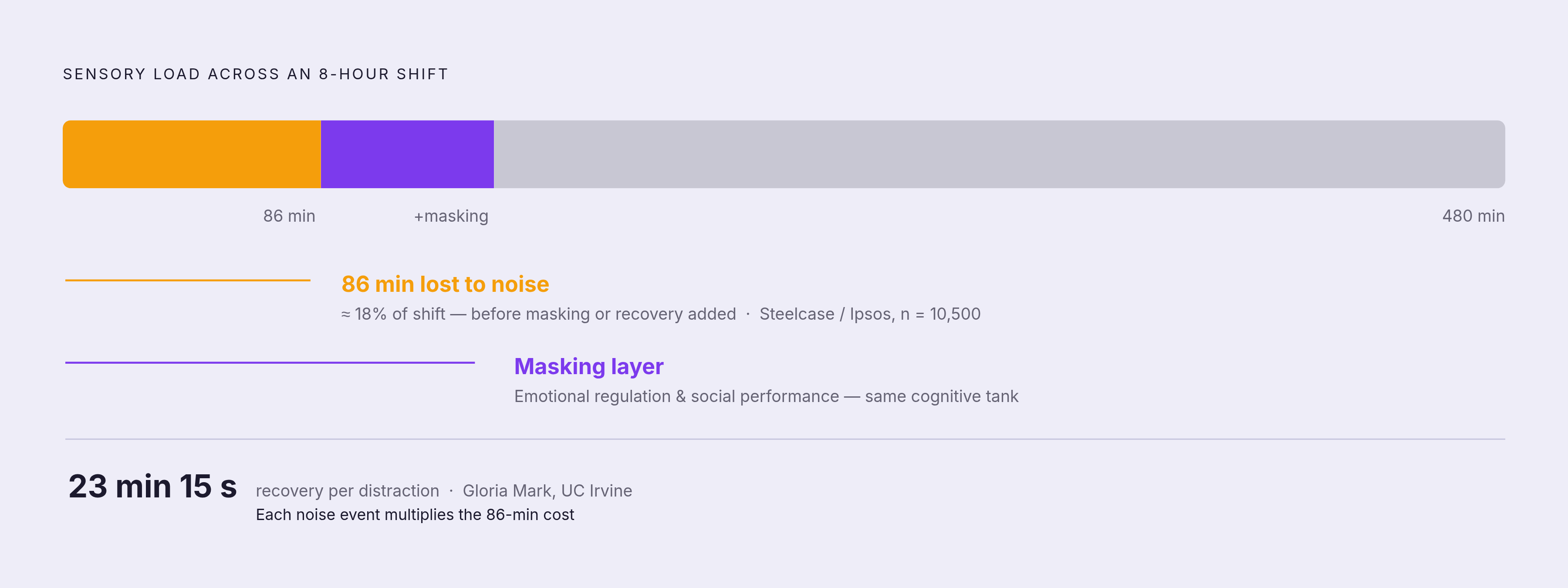
The math gets ugly here. Gloria Mark's research at UC Irvine found it takes an average of 23 minutes and 15 seconds to fully recover depth of focus after a single distraction. A Steelcase and Ipsos survey of more than 10,500 workers across Europe, North America, and Asia found workers lost as much as 86 minutes a day, close to 18% of an 8-hour shift, to noise distractions alone. Multiply nearly 24 minutes of recovery time by how often interruptions actually happen on an open floor, and the conclusion isn't complicated: most people never get back to genuine deep focus during the day.
There's a second cost sitting on top of the sensory one, and it's mostly invisible. Call it the masking layer: the effort of keeping a neutral face during a noisy meeting, making small talk on cue, looking engaged when the brain is already stretched thin. That effort draws from the same regulatory tank as the sensory processing itself, so the two drain the person simultaneously.
Recovery has to be the right kind, or it doesn't work. In the 2011 study, participants who remained in office noise during the recovery period showed more negative motivation effects than those who listened to nature sounds or watched a nature film. Recovery isn't just a pause in tasks. It requires actual withdrawal from the sensory load, not just a break from typing. Researcher Julian Treasure has estimated that workers in open offices run 66% less productive than they do working privately, a striking number, though it lands better paired with the mechanism behind it than as a standalone headline. And this fatigue doesn't stay contained to the workday. Britain's Health and Safety Executive found anxiety and depression accounted for 49% of work-related health issues and 54% of lost workdays in 2022/23, averaging 19.6 days per case and potentially costing businesses $3,200 per employee a year. Sensory-load fatigue is one real thread in that larger pattern.
Neurodivergent workers bear a disproportionate share of the open-plan cognitive burden
Roughly one in five workers identifies as neurodivergent, a number that's likely undercounted and expected to climb as Gen Z keeps entering the workforce. For this group, the open-plan tax isn't an inconvenience, it's often the difference between a workable day and an unworkable one.
Reviews in BMJ and Frontiers in Psychology describe adults with ADHD as more sensitive to noise, movement, and visual clutter, with cognitive load rising and sustained focus getting harder to hold. The catch is that this difficulty depends on how much capacity a person has left that day. The same open office that's tolerable when someone's rested becomes impossible when they're not. For autistic adults, sensory over-responsivity is part of the diagnostic picture itself, and the triggers tend to be specific and consistent rather than random. Sensory avoidance in autistic adults has been linked to higher anxiety and loneliness, which raises a hard question: what does it cost someone to spend energy avoiding a trigger instead of doing the work they were hired for?
A vigilance cycle drives what follows. Repeated exposure to sensory input a person can't predict or control puts the brain into a state of ongoing threat-monitoring, and that vigilance is exhausting on its own, separate from the overload itself. Sometimes just anticipating the next disruption costs as much as the disruption would. EEG research from Corgan and the University of Arkansas, focused on inattentive-type ADHD, found office-environment effects on focus that the researchers say apply to the broader workforce too: studying the group that struggles most often reveals mechanisms running quietly in everyone else. A 2022 and 2024 systematic review by Weber and colleagues in Applied Psychology looked specifically at physical workplace adjustments that support neurodivergent workers, a sign that this conversation is moving past policy statements and into actual design evidence. Sensory sensitivity here isn't a preference, it's measurable and documented. An environment that's merely suboptimal for one worker can be functionally exclusionary for another.
Spatial scale's effect on cognitive outcomes: how room dimensions shape performance
Office layouts often fail to account for size. The small rooms won on cognitive performance. Larger rooms may suit collaborative work better, but they didn't help anyone trying to focus alone. An economic analysis built into the same study found the smaller spaces delivered a 23.37% increase in benefits over the larger ones, enough to offset the higher construction cost per square foot that comes with building more, smaller rooms.
The finding isn't clean across every measure. The small spaces slightly raised anxiety on self-report measures even as they improved cognitive scores. A room can help someone focus and still feel less comfortable to sit in. Gains in one outcome, cognitive performance, didn't reliably appear in others, like mood or perceived workload. So the takeaway isn't "build smaller rooms and move on." It's that the cognitive cost of open-plan work comes from environmental load in aggregate, and spatial scale is one lever, among several, that determines how much of that load reaches any one person.
Interventions that can reduce the load by addressing the mechanism rather than the symptom
The clearest experimental evidence for what works comes back to the Pérez-Martínez pod study: the enclosed condition showed the brain settling rather than ramping up over time. That's the most direct proof available that physical enclosure functions as a cognitive intervention, not just a sound barrier. Pods work because they hit several channels at once: they cut speech intelligibility, limit visual movement, and hand the worker a predictable micro-environment they don't have to keep adapting to.
Spatial design offers a lighter-touch version of the same idea. If smaller rooms improve focus the way the Building and Environment study found, then breaking a large open floor into distinct zones, rather than enclosing every desk, can capture part of that benefit without the cost of full construction. Activity-based working pushes in the same direction: match the room to the task, quiet zones for focused work, open areas for collaboration, so the environment isn't fighting the work happening inside it.
On the acoustic side, the ratio of speech to background noise affects focus more than achieving total silence. Masking systems and acoustic materials that raise the ambient noise floor make nearby conversation harder to parse as language, which directly undercuts the irrelevant speech effect described earlier. Hot-desking deserves a second look too: rotating seating strips away the predictability that lets people build small coping habits, so stable or semi-stable seating might do more for cognitive load than the flexibility it's marketed on.
Recovery deserves its own real estate, not just a hallway to walk down. Jahncke's 2011 findings showed genuine recovery needs actual sensory withdrawal, nature sounds, visual nature access, not simply stepping away from a screen. A restoration space that delivers that kind of quiet matters just as much as the design of the work environment itself. None of these fixes work in isolation. The sensory load on an open floor comes from several channels running at once, so the interventions that actually move the needle are the ones addressing more than one channel at a time.
Sources
- Open-plan office noise : Cognitive performance and restoration | Request PDF
- Larger or smaller? The effects of open-plan office spatial dimensions on human mood, productivity and economic benefit - ScienceDirect
- Investigating the effects of exposure to office noise types on cognitive function and noise annoyance based on personality characteristics: An experimental study - Ali Sobhani Dargah, Mohsen Aliabadi, Maryam Farhadian, Rostam Golmohammadi, Mohammad Babamiri, 2025
- Open-Plan Offices Could Be Hurting Employees’ Brains, New Research Suggests
- Why your brain has to work harder in an open-plan office than private offices: study
- Open-plan office noise: Cognitive performance and restoration - ScienceDirect
- Prospect and Refuge in the Workplace: An Exploratory Pilot EEG Investigation of Desk Orientation and Hypervigilance Among Adults with ADHD
- Temporal Trajectories in EEG-Based Mental Workload: Effects of Workspace Type