LLM vs Transformer Distinction for Practitioners
Transformers are an architectural blueprint; LLMs are trained systems built on top of them.
Start with Vaswani et al., 2017. "Attention Is All You Need" introduced a neural network design built around alternating multi-head self-attention and position-wise feed-forward layers, connected by residual streams. The paper was solving something concrete: recurrent neural networks processed sequences step by step, which made parallelization painful and long-range dependencies difficult to preserve. Convolutional architectures had similar limitations for sequence modeling.
Attention solved this by letting a model weigh relationships between every position in a sequence simultaneously. Every token can, in principle, attend to every other token in a single pass. But what does that mechanism actually tell you? Nothing about what a model was trained to do, what data it saw, or what task it gets deployed for. The transformer specifies how information flows through a network. It is a blueprint, not a building.
And yet "transformer" and "LLM" get used interchangeably, in blog posts, job descriptions, vendor documentation, and casual conversation between people who clearly know better. The conflation is so pervasive it starts to feel definitional, as if the terms were synonyms at different levels of formality. They are not. One is an architectural pattern. The other is a trained system built on top of one.
The costs of that confusion are real and they compound. You fine-tune an encoder expecting generative output. You build a retrieval pipeline on a decoder-only model and spend two weeks wondering why the embeddings underperform. The mismatch is baked in early, which is exactly why it takes so long to surface.
The original 2017 blueprint made specific choices: post-layer normalization, sinusoidal positional encodings, ReLU activations. Note them now, because almost none survive intact inside a modern LLM.
What makes a model an LLM: scale, training data, and emergent behavior
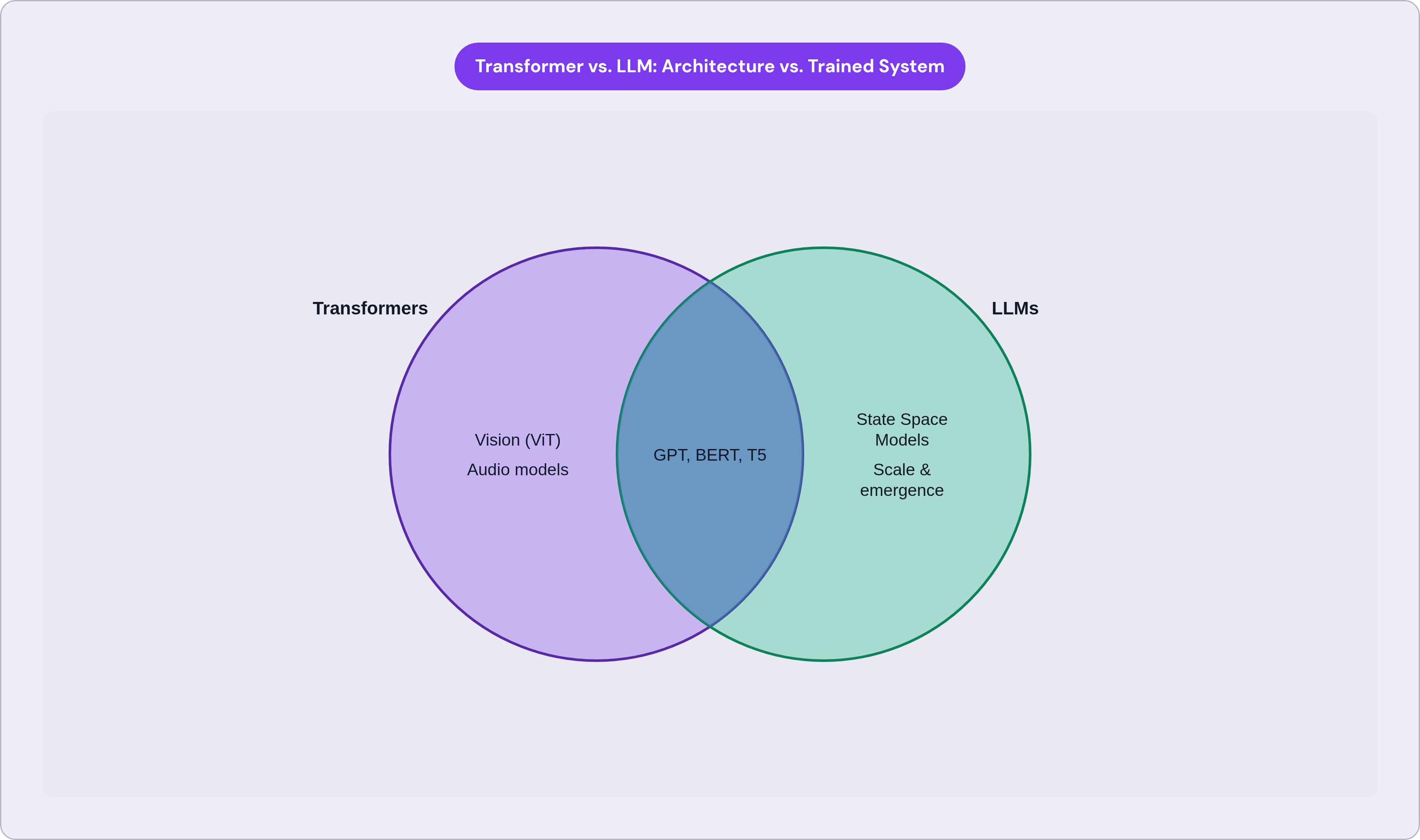
An LLM is defined by what it was trained on and at what scale, not by which architectural family it belongs to.
A large language model is a trained system. It has been exposed to vast text corpora and optimized toward a language objective, most commonly next-token prediction. The word "large" has no agreed parameter threshold; it is a fuzzy designation by design, and it has been drifting upward for years. GPT-1 had 117 million parameters. GPT-3 reached 175 billion. GPT-4 was reportedly trained with roughly 1.8 trillion, a roughly 15,000x increase across about five years.
Scale does not produce linear capability gains, and this is where things get strange. At certain thresholds, emergent behaviors appear: language understanding, mathematical reasoning, multimodal interaction, none of which were explicitly trained for. They arose from scale itself. That raises an important question: if capabilities emerge from training volume rather than explicit design, what does that tell you about how to define and categorize these systems? The category is defined by training characteristics, not architectural ones.
NIST AI 600-1, published in July 2024, places LLMs within Generative AI, describing systems that "emulate the structure and characteristics of input data to generate derived synthetic content." That framing is useful because it anchors the definition functionally, at the level of what the system does and how it was built to do it, not at the level of which layers its architecture uses.
The three encoder/decoder variants and which problems each actually solves
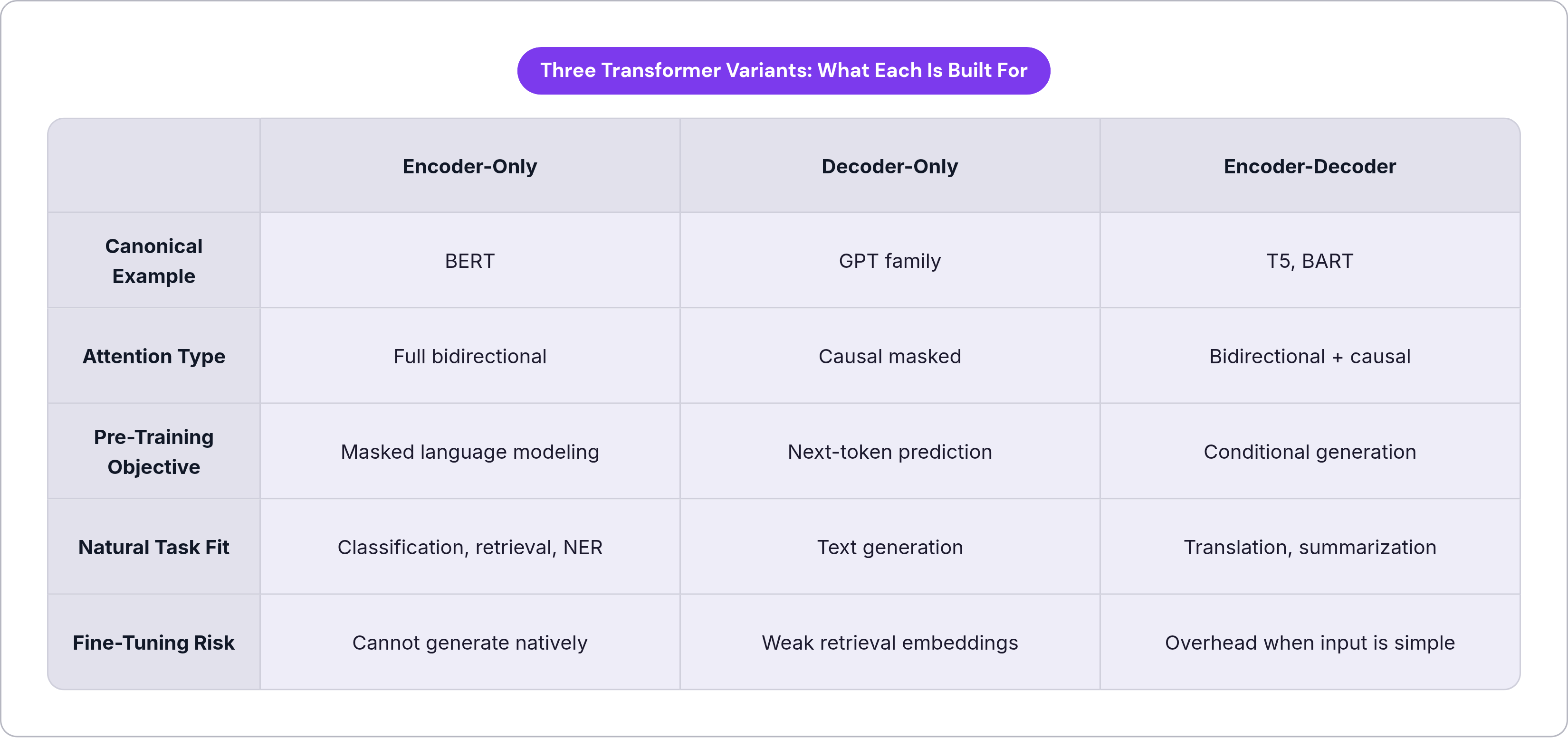
Before "LLM" became the dominant vocabulary, practitioners talked about encoder-only, decoder-only, and encoder-decoder models. That three-way split still governs the most consequential model selection decisions anyone actually makes.
Encoder-only models, BERT being the canonical example, apply full self-attention over the entire input simultaneously. Pre-trained with masked language modeling, where random tokens are hidden and the model learns to predict them, they develop rich bidirectional representations. Precisely suited for classification, retrieval, entity extraction, any task where understanding a complete sequence matters more than generating a continuation of it. BERT, released in 2018, still accumulates tens of millions of monthly downloads on the Hugging Face hub, not because practitioners are sentimental, but because its architecture is structurally correct for retrieval-augmented generation pipelines, content moderation, and named entity recognition. Encoder-only is not obsolete; it is the right tool for problems that did not disappear because GPT-4 exists.
Decoder-only models, the GPT family being the obvious example, use causal masked attention: each token can only attend to past tokens. Autoregressive, generating by predicting what comes next, one token at a time. This is the architecture that dominates text generation in production today.
Encoder-decoder models, sometimes called seq2seq, pair an encoder that processes the full input with a conditioned decoder that generates output. Translation and summarization are their natural domain, tasks where the relationship between a complete input and a complete output needs to be modeled explicitly.
The practitioner error that sinks otherwise solid projects is not choosing the wrong model size. It is choosing the wrong variant. The variant determines what kind of prediction the model was architecturally built to make. Fine-tuning an encoder for generation, or expecting retrieval-quality embeddings from a causal decoder, does not fail gracefully. It fails in confusing ways that are hard to trace back to the original mismatch, which is what makes it expensive.
Transformers that are not LLMs: vision, audio, and protein structure
The attention mechanism is modality-agnostic. Any data that can be serialized into a sequence of tokens can flow through a transformer. That insight opened a wide territory of applications with no relationship to language.
Vision Transformers, introduced at ICLR 2021 in "An Image Is Worth 16×16 Words," treat image patches as tokens. Instead of convolutional filters learning local features, ViTs learn global feature representations directly from raw images, spanning object detection, segmentation, synthesis, and video understanding. None of these are language tasks. None of these models are LLMs.
Audio transformers apply similar logic to spectrograms. The architecture does not know it is processing sound. It processes the sequence.
AlphaFold is probably the most consequential example. It uses a transformer-based architecture called the Evoformer to predict three-dimensional protein structure from an amino acid sequence alone. AlphaFold 3 expands to a broader spectrum of biomolecules, incorporating diffusion into the transformer-based design. The AlphaFold 3 paper had accumulated more than 9,000 citations as of November 2025, a signal of how deeply consequential non-LLM transformer applications have become in science.
It is also worth considering what happens when you encounter a transformer-based model in a non-language domain: the entire framing of context windows, token limits, and prompt engineering is the wrong mental model. Those are LLM concerns, not transformer concerns. The distinction is load-bearing, and borrowing the wrong frame creates debugging problems that compound.
LLMs that are not (pure) transformers: state space models and the efficiency challenge
The transformer's core constraint is self-attention's quadratic scaling with sequence length, in both time and memory. For short to medium contexts, manageable. For very long contexts, a hard engineering wall.
State Space Models, and particularly the Mamba architecture, address this by compressing past context into a fixed-size recurrent state rather than maintaining a full key-value cache for every past token. The result is linear-time sequence modeling.
In 2024, the Technology Innovation Institute released Falcon Mamba-7B, the first 7-billion-parameter attention-free model to match or beat same-size transformer models and, in some evaluations, outperform larger ones. That result matters because it means "LLM" is now a functional category, a large-scale language system, not an architectural one.
The current weakness is concrete. On the five-shot MMLU benchmark, both Mamba and Mamba-2 produce nearly 15 points lower accuracy than comparable transformers after 1.1 trillion tokens of training. In-context learning and information retrieval from context are where pure SSMs currently struggle, and that gap is not a rounding error.
Hybrid SSM-Transformer designs attempt to close it. H3 stacked two SSM layers with multiplicative gating and retained only two attention layers, matching full transformer performance at the 1.3B to 2.7B parameter scale. An 8B Mamba-2-Hybrid built from 24 Mamba-2 layers, 4 attention layers, and 28 MLP layers represents the same design logic: SSM efficiency for most of the model, attention where in-context learning is critical.
The architecture and the application have been separating for a while now. Evaluating an LLM purely by its transformer lineage will increasingly miss what is actually happening in the field.
How the modern LLM transformer diverged from the 2017 original
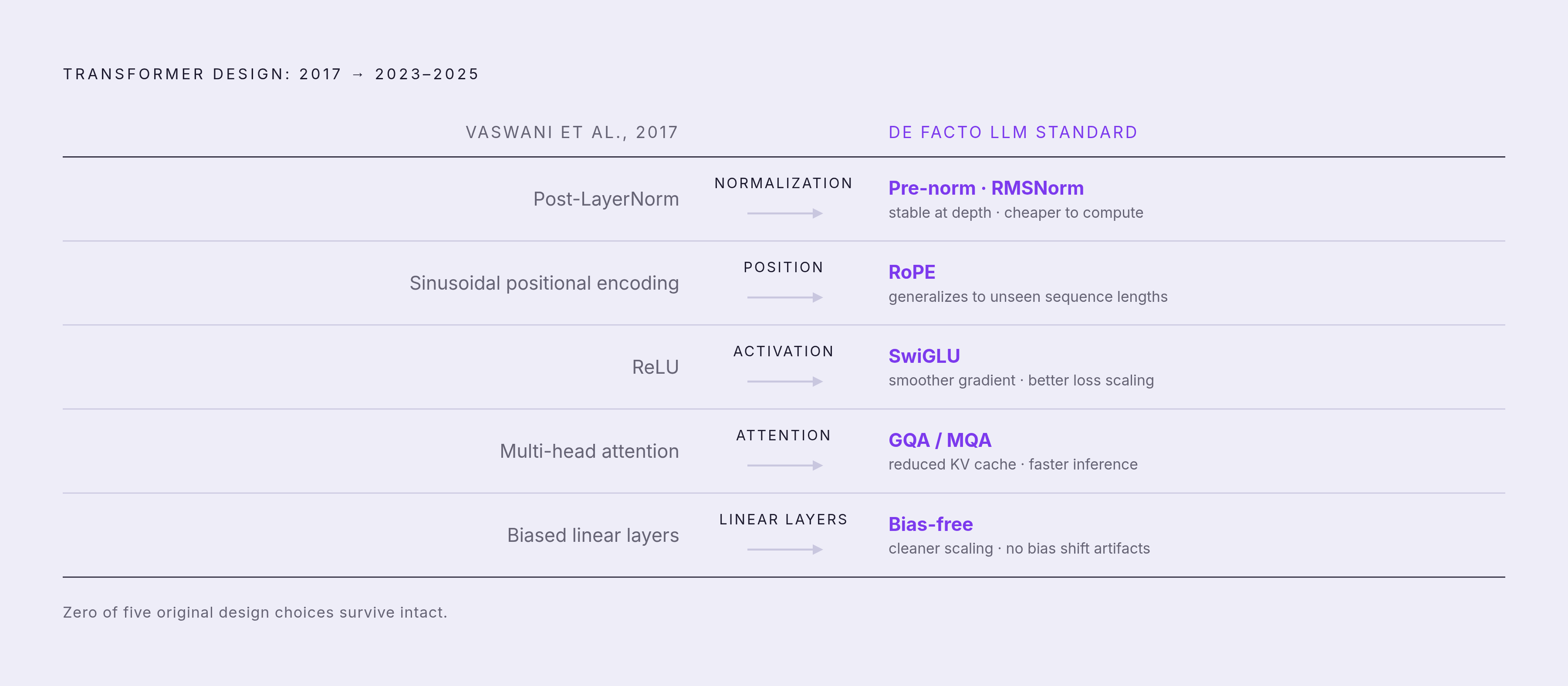
Between 2017 and roughly 2023, transformer designs for LLMs went through rapid, unsystematic experimentation. By 2023 to 2025, a de facto standard stack had emerged, and it looks substantially different from what Vaswani et al. published.
Analysis across dozens of modern models identifies the consensus: pre-norm using RMSNorm instead of post-LayerNorm; Rotary Positional Encodings replacing sinusoidal encodings; SwiGLU activations replacing ReLU; key-value sharing via Multi-Query Attention or Grouped-Query Attention; bias-free linear layers throughout.
Each change has a concrete rationale. RMSNorm with pre-norm placement improves training stability at scale. RoPE generalizes better to sequence lengths not seen during training, which matters enormously for long-context inference. SwiGLU produces empirically better task performance than ReLU at large scale. GQA and MQA reduce inference memory overhead, a critical consideration when serving long contexts to many simultaneous users.
A framing that emerged in 2025 is "capability density": newer models achieve more capability per parameter, meaning these architectural refinements produce compounding gains beyond raw scale. More from fewer, if the architecture is right.
The word "transformer" on a model card tells you the broad architectural family, not the specific design. But how does this affect model comparison in practice? Two "transformers" can be quite different machines. Knowing the component choices, norm type, positional encoding scheme, attention variant, is what enables meaningful comparison. Performance gaps that appear mysterious at first glance often trace directly to differences at this level, the kind of thing that costs teams real time when the underlying architecture is treated as a black box.
Where LLMs end and SLMs begin, and why the line affects deployment choices
Industry shorthand commonly treats under roughly 10 billion parameters as an SLM, while some researchers describe the range as "a few million to a few billion." Neither is a formal definition; both are deployment heuristics.
Structurally, SLMs and LLMs share the same architecture: stacked decoder-only transformer layers, autoregressive generation. What differs is depth, attention head count, hidden dimension size, and the volume and curation of training data. The architectural family is identical; the scale and resulting capability profile are not.
Mixture-of-Experts architectures complicate parameter counting in ways that matter practically. DeepSeek V4 Flash reports 284 billion total parameters but only 13 billion active per forward pass. The active parameter count governs inference cost and effective capability at runtime; the headline total does not. When evaluating a model for deployment, the active figure is the relevant one. The headline is, at best, a distraction.
Real-world download patterns on the Hugging Face hub show that SLMs are chosen frequently in production. Practitioners are prioritizing deployability and cost efficiency over raw capability in a substantial share of actual use cases. One might argue this signals a maturing field, one where raw benchmark performance is no longer the only decision criterion, and that is worth sitting with before defaulting to the largest model available.
The practical decision criteria sort out clearly. On-device or edge deployment favors SLMs by necessity. Cost-sensitive, high-volume inference favors SLMs or MoE models with low active parameter counts. Complex reasoning, long context, and multi-step tasks push toward full-scale LLMs. Retrieval and classification favor encoder-only transformers that are neither LLMs nor SLMs in the conventional sense at all.
Applying the three-axis distinction to model selection, fine-tuning, and tooling decisions
Three axes have been running through this piece. At the selection stage, they get applied directly.
Architecture versus application. Identify the task type before selecting a model family. Generation, classification, retrieval, and structured prediction each have a natural architectural home: encoder-only for embedding and retrieval, decoder-only for generation, encoder-decoder for conditional generation where both input and output require full modeling.
This matters most for fine-tuning. The architectural variant determines what fine-tuning even means, which layers respond to which objectives, what kind of output the tuned model can produce. Applying fine-tuning intended for a generative decoder to an encoder produces a system trained to do something its architecture cannot cleanly express. The failure is confusing precisely because the mismatch is introduced early and surfaces late.
Modality versus scale. If the task is not language, LLM-centric tooling assumptions are the wrong frame. Prompt templates, token budgets, instruction tuning: language system concerns. Vision, audio, and biology tasks need their own evaluation frameworks, their own debugging approaches, their own sense of what "good" looks like.
Multimodal models blend architectures, sometimes with a separate vision encoder feeding into a language decoder. Knowing which component handles which modality lets practitioners debug behavior correctly and choose evaluation metrics that are actually informative, rather than borrowing metrics from a domain that does not apply.
Training objective versus use case. A model's pre-training objective creates systematic strengths and systematic blind spots. Fine-tuning can adjust them; it rarely eliminates them. Next-token prediction produces models that are fluent and generative but sometimes confidently wrong. Masked language modeling produces models with strong bidirectional representations but no native generative capacity. Contrastive objectives produce models optimized for similarity and ranking.
The 15-point MMLU gap documented in current SSM benchmarks is worth holding onto here. Architectural novelty carries a capability cost in at least some dimensions, and knowing what a model was trained to do, by what objective, is what lets a practitioner anticipate where it will struggle before that failure appears in production.
The tooling layer. Platforms that surface model architecture metadata reduce the distance between picking a model and understanding what you are actually deploying. Norm type, attention variant, training objective, active versus total parameter count: these variables determine behavior, and they should be visible at the selection stage rather than reconstructed from scattered documentation after a failure.
The distinction between transformer and LLM is, at its core, a distinction between a mechanism and a system built to exploit it. Keeping that separation clear does not require pedantry. It requires asking, before committing to a model, what the architecture was built to do versus what it was trained to do. Those are different questions. Conflating them is where the quietly expensive errors begin.