Declarative Memory Consolidation During Sleep
Precise timing of brain rhythms during sleep matters more than hours spent asleep.
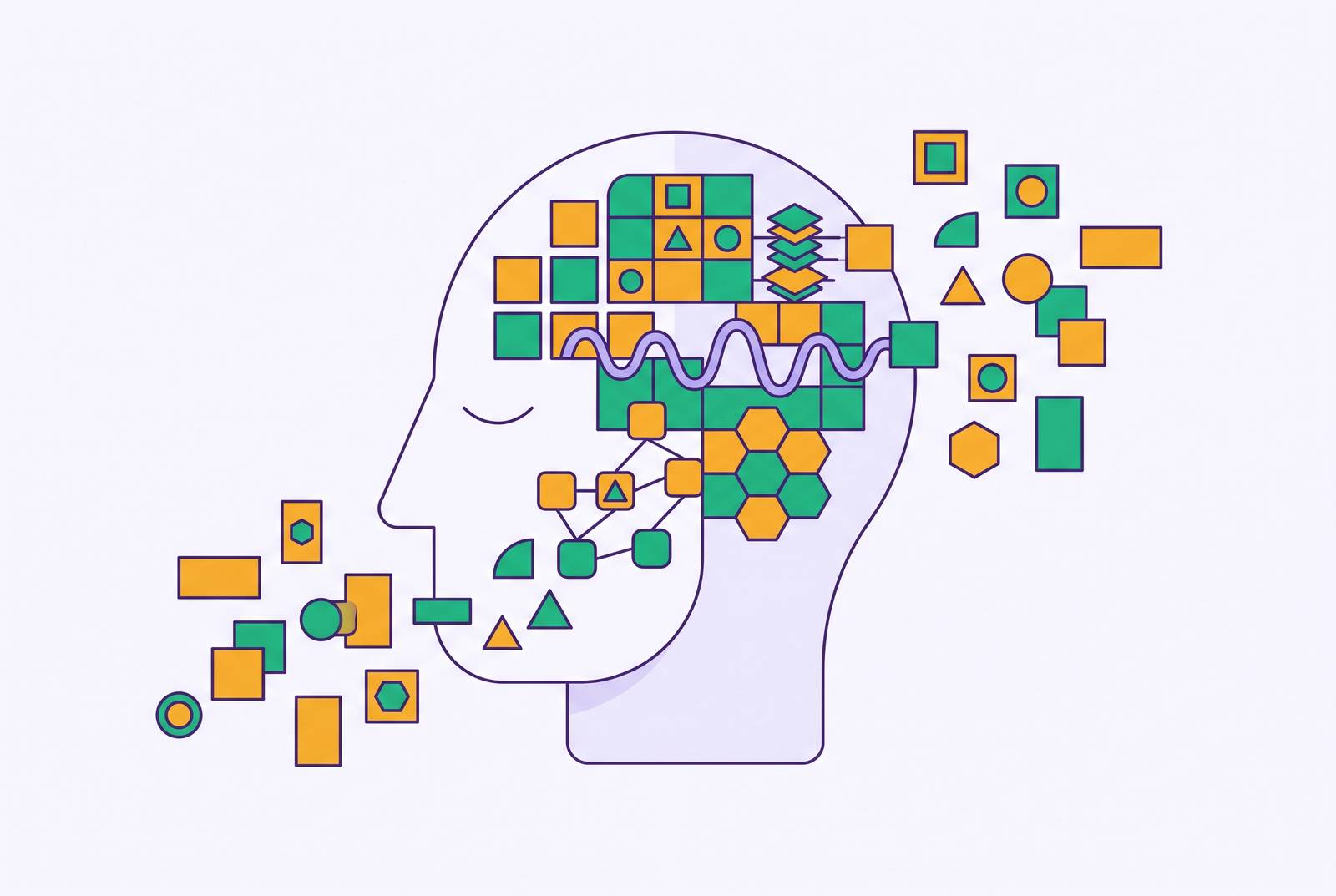
Declarative memory consolidation during sleep is the brain’s active work of reorganizing newly learned information. Its success depends on how precisely brain activity is timed as well as on how many hours are spent asleep. Understanding that timing explains why sleep quality matters so much for what survives the night, how memories change, and the capacity to learn again.
Why sleep became the wrong metaphor for what the brain does at night
People often assume that more sleep means better memory. That makes sense if sleep merely shelters new memories from the interference of waking life. On that account, a longer period of shelter should offer more protection. But a century of empirical work establishes that sleep actively supports consolidation. Hours alone are therefore the wrong unit for explaining what the brain accomplishes.
During slow-wave sleep, the brain brings activity into step to reactivate and redistribute what was just learned. To understand whether a night supported memory, the important distinction is between time available for that work and the events that actually performed it.
The three-oscillation handshake that does the actual work during slow-wave sleep
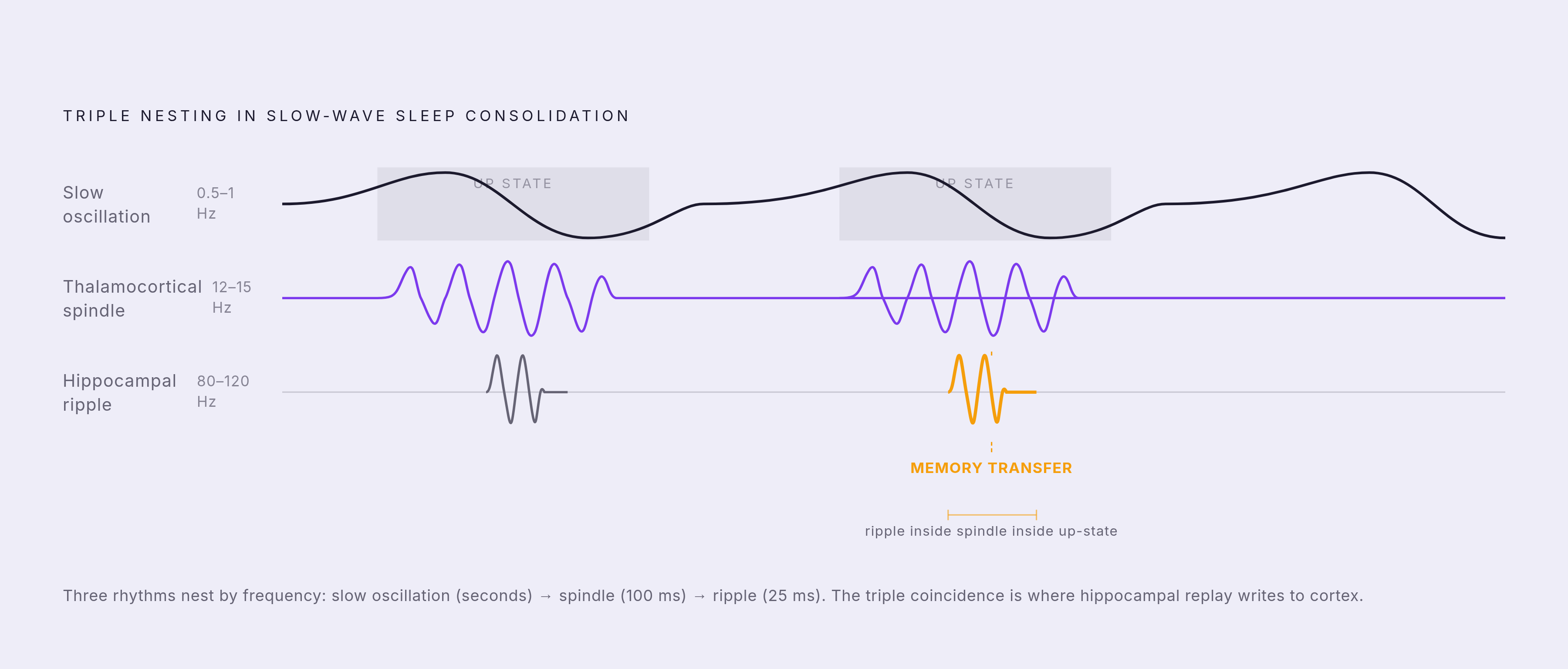
The Active Systems Consolidation hypothesis describes how newly encoded declarative memories, initially stored in the hippocampus, become integrated into cortical networks. This transfer depends on three coordinated rhythms, which are hippocampal sharp-wave ripples, cortical slow-oscillations, and thalamocortical spindles. Slow-oscillations create an up-state that permits spindles to occur. Ripples nest within those spindles, creating brief windows in which hippocampal replay can reach the cortex.
The rhythms need to meet at the right moment. Human EEG work therefore emphasizes the timing and coupling of activity within a sleep stage that constitute sleep microstructure. These are “write windows,” not one uniform offline state. Disrupting their coordination can disrupt consolidation even when substantial time is spent in slow-wave sleep.
Chemical signals also gate those windows. Norepinephrine falls during recurring low phases in NREM sleep, allowing spindles and slow-oscillation–spindle coupling to proceed. Premature norepinephrine activity interrupts that coordination and cortical storage. Acetylcholine has a complementary role, supporting encoding when elevated during wakefulness but interfering with hippocampus-dependent consolidation if it remains elevated during sleep. The brain needs the right chemical conditions as well as the right electrical timing.
What the 2026 computational model reveals about replay and ripples
That account raises a further distinction between the signal that accompanies memory processing and the event that carries it. Dutta’s 2025 computational model, available as a bioRxiv preprint, separates replay from sharp-wave ripples in an entorhinal-hippocampal-cortical network. Weakening afferent CA1 synapses eliminates ripples while leaving replay intact. Systems consolidation then continues more slowly, showing within the model that ripples can accelerate the process without being indispensable to its initiation.
The model also links the transition into slow-wave sleep to changes in inhibition. Dampened inhibition produces up-down states that drive time-compressed spontaneous replay of spatial sequences. This places replay, rather than the ripple alone, at the center of the modeled transfer. It also makes the coordination story more exact, because a visible rhythm and the memory event it accompanies need not be identical.
The boundary matters here. A computational preprint is not a settled demonstration of how every sleeping human brain behaves, and the field has not yet fully absorbed the finding. Targeting ripples alone could mean targeting a proxy rather than the core process those ripples usually accompany.
How consolidation restructures memory rather than simply storing it
Repeated reactivation integrates new information into existing cortical schema, making memories more abstract and less dependent on their original episode. Salient information can become more resistant to interference while peripheral details fade. The process can succeed even when some detail is lost after sleep.
The roles of different sleep stages complicate this transformation. One prominent account proposes that slow-wave sleep builds neocortical gist-like representations and REM sleep then consolidates what was reactivated. Liu et al.’s 2025 study in Communications Biology tested that sequential account but found differential, even opposing, roles for the two stages. Greater REM relative to slow-wave sleep drove gist-level abstraction. The finding supports a role for sleep-stage balance without confirming a simple division into transfer first and reinforcement second.
Dreaming may offer a subjective reflection of some of this work. The integration of recent and remote memory fragments is receiving empirical attention as a possible correlate of consolidation. That possibility is a clue about memory processing.
Why sleep quality determines what you remember, not how many hours you slept
The distinction between sleep duration and sleep quality now has a biological basis. Total time in slow-wave sleep does not establish whether coupling events occurred often enough or with sufficient precision. Fragmented sleep can provide adequate duration while repeatedly interrupting the conditions needed for transfer. Noise, apnea, alcohol, and aging-related changes can also disturb the sequence of slow-wave and REM sleep.
It is tempting to assume that enough extra time must eventually make up the difference. But that assumes a coupling event has the same chance of succeeding throughout fragmented sleep. The mechanism gives no such guarantee, because fragmentation resets the oscillatory context that permits coupling. More time does not automatically repair coordination.
In older adults, reduced deep sleep can limit consolidation through degraded slow-wave microstructure and coupling. In children and young adults, sleep supports declarative and associative memory and vocabulary learning when that architecture is intact.
Sleep consolidation also prepares the brain for learning the next day
Consolidation may also change what the brain can do after waking. The resource reallocation hypothesis proposes that redistributing memories from the hippocampus to the neocortex frees hippocampal encoding capacity for new learning. On this account, processing yesterday’s material helps prepare for tomorrow’s. That would make the consequences of disrupted sleep prospective as well as retrospective.
The evidence, however, is not conclusive. Prior preregistered studies found that participants who slept before another learning session retained earlier memories better, but showed no statistically significant advantage in new learning over an awake group. Exploratory analyses controlling for baseline memory performance found a relationship between overnight retention and next-day learning that was absent in the awake control group. That correlation supports further investigation.
The careful interpretation is therefore broader than hippocampal clearance alone. Efficient learning after sleep may depend on overlapping or independent mechanisms. Sleep loss can compromise both prior consolidation and the capacity to encode new material, but the precise causal bridge between those effects remains under debate.
The active debate between systems consolidation and synaptic homeostasis
That uncertainty connects to a deeper question about what sleep does to connections between neurons. Active Systems Consolidation emphasizes selective reactivation and strengthening of memory-relevant assemblies during hippocampal-to-cortical transfer. The Synaptic Homeostasis Hypothesis, developed by Giulio Tononi and Chiara Cirelli, emphasizes a different need. Waking experience produces net synaptic strengthening, and sleep restores balance through global proportional downscaling. This reset can prevent saturation and improve signal-to-noise.
At first, selective strengthening and widespread weakening seem incompatible. But the accounts address different scales, namely the organization of memories across brain systems and the adjustment of synaptic strength. During NREM sleep, downscaling can occur while memory-related assemblies are reactivated and their strength is preserved or potentially enhanced. REM sleep may then help weaken connections across the wider network after memory-specific connections have been secured.
This is a possible reconciliation. Technical limits leave the relationship between systems-level reorganization and local synaptic refinement unresolved. Wakeful rest also helps offline consolidation, but little is known about how it and sleep do the same work. Sleep-stage interdependence is important precisely because no single operation yet explains the whole outcome.
What happens to memory consolidation when sleep architecture breaks down in Alzheimer’s disease
Alzheimer’s disease makes the consequences of damaged architecture especially concrete. Vulnerable regions overlap with the hubs that support oscillatory consolidation, including the entorhinal cortex, hippocampus, thalamus, and locus coeruleus. The entorhinal cortex provides a gateway for hippocampal input, while the hippocampus supplies replay. The thalamus generates spindles, and the locus coeruleus regulates the norepinephrine conditions that permit their coupling. Damage in these regions can therefore interfere with several parts of the same coordinated process.
The relationship between sleep and disease is bidirectional. Pathology disrupts sleep architecture, while disrupted sleep is linked to neuroinflammation, reduced amyloid-β clearance, increased tau hyperphosphorylation, and accelerated neuronal apoptosis. These pathways reach beyond a single night’s failure to consolidate a memory. They help explain how disturbed sleep and cognitive decline can reinforce each other.
A large Mayo Clinic study published September 2025 found that people with long-term sleep troubles were more likely to develop dementia or cognitive impairment. Scans of the brain also showed changes linked to cerebrovascular disease and Alzheimer’s disease. A January 2025 UCSF study found that taking significantly longer to enter REM sleep may be an early symptom of Alzheimer’s disease. These findings place sleep architecture within the disease picture.
Targeted memory reactivation and the deliberate use of the oscillatory window
Home-based work with wearable EEG has demonstrated that targeted memory reactivation can operate outside a laboratory, with a benefit for acquiring a novel language. This shows the science at work, though more work is needed before it can become a treatment for consumers. The method re-exposes a sleeping person to sensory cues associated with earlier learning, such as sounds or odors. During NREM sleep, those cues can trigger reactivation of the corresponding memory trace. Closed-loop delivery uses what the brain is doing at the time to decide when to intervene.
The refinement is not simply to provide more cues. Timing stimulation to the spindle helps engage the window in which natural consolidation already operates. Shin et al.’s 2025 study in npj Science of Learning also showed the value of tailoring stimulation to the learner. A word-pair protocol tailored to each learner changed stimulation frequency based on how well they could retrieve memories and how hard the task was, making it work better for memories that were hard to recall.
These findings offer proof of concept for engaging the mechanism deliberately. Use for mild cognitive impairment and Alzheimer’s disease shows promise, but has yet to become an established treatment. Closed-loop reactivation during wakeful rest is another avenue for investigation. The state of the receiving brain matters as much as the cue being delivered.
What the mechanism means for how anyone should think about their own sleep
To understand sleep, it helps to ask more than how many hours passed. It also asks whether the night’s architecture supported the coordinated events that memory processing requires. Duration is a useful proxy only insofar as it provides those opportunities. Fragmentation and altered stage timing can weaken that relationship without necessarily shortening the night.
This perspective gives sleep quality a meaning beyond a vague sense of having rested well. It concerns the conditions under which the brain organizes information, preserves salient content, and changes the form of a memory. The emerging intervention work shows that those conditions can sometimes be engaged deliberately, while the unresolved theoretical questions show why claims of complete control would be premature. Understanding the mechanism gives people a clearer way to think about sleep and act on that knowledge, while leaving limits on how much they can measure or manage every oscillation.
Sleep is part of the processing that makes later thought possible, integrating what was learned and potentially preparing capacity for what comes next. The clock records how long sleep lasted. It does not, by itself, record how well that work was done.
Sources
- REVIEW ARTICLE SLEEP’S CONTRIBUTION TO MEMORY FORMATION AUTHORS
- Systems memory consolidation during sleep: oscillations, neuromodulators, and synaptic remodeling
- Sleep and memory consolidation: Neural and cognitive perspectives - PubMed
- Does overnight memory consolidation support next-day learning? - PMC
- Sleep-modulated disinhibition enables replay for memory ...
- Slow-wave sleep and REM sleep differentially contribute to memory representational transformation