Context Switching Costs for Founders and How AI Reduces Them
AI helps founders recover from interruptions without rebuilding complex mental models from scratch.
For solo founders and small teams managing multi-tool context switching, the useful AI assistant is one that preserves context across work. This article explains how AI can reduce the cost of reconstructing decisions, priorities, and open questions after an interruption. The goal is to protect founder judgment.
Why founder attention is the startup's most constrained resource
A founder can finish a full day of meetings and emails without advancing a single strategic question. Every conversation had a point, and every reply seemed needed. Yet the investor narrative remains unwritten, while the possible pivot has received only passing thought. The day was busy but strategically thin. Context switching helps explain the gap between that visible activity and the work left undone.
In an early-stage company, the founder is the decision-making node through which every domain passes. A distracted VP in a large organization may slow one workstream, while a distracted founder can slow them all. There is little redundant decision-making capacity to absorb the loss. Capital and headcount cannot fully compensate when the person connecting product, sales, hiring, and financing cannot sustain attention.
The most consequential work is also the most vulnerable. Evaluating a pivot or designing a compensation structure that will hold for three years requires keeping many connected considerations in mind. Those mental models do not fit neatly into gaps between calls. The American Psychological Association reports that mental blocks caused by switching tasks can reduce productivity by as much as 40%. For founders, that loss falls on the thinking that gives everyone else direction.
What context switching actually does to a working brain
After attention moves elsewhere, returning requires reconstructing what was relevant, how the pieces connected, and where the reasoning stopped. That reconstruction is called resumption lag. It is a feature of how attention works.
The APA describes switching costs that increase with task complexity. Gloria Mark’s UC Irvine field studies are the source of the roughly 23-minute recovery figure often discussed in relation to interruptions, rather than an APA finding about a fixed neurological reload time. The distinction is important. A simple task and a complex strategic question do not impose identical demands, so one recovery estimate should not become a stopwatch applied to every switch.
Time is only one part of the cost. Founders also report making worse decisions when they resume before the full context has returned, although this effect is less studied. A forgotten constraint can leave a decision resting on less information than an uninterrupted session would have supplied. When the founder reasons with pieces missing, that can shape what the team chooses to do next.
How the founder's day turns resumption lag into cumulative hours lost
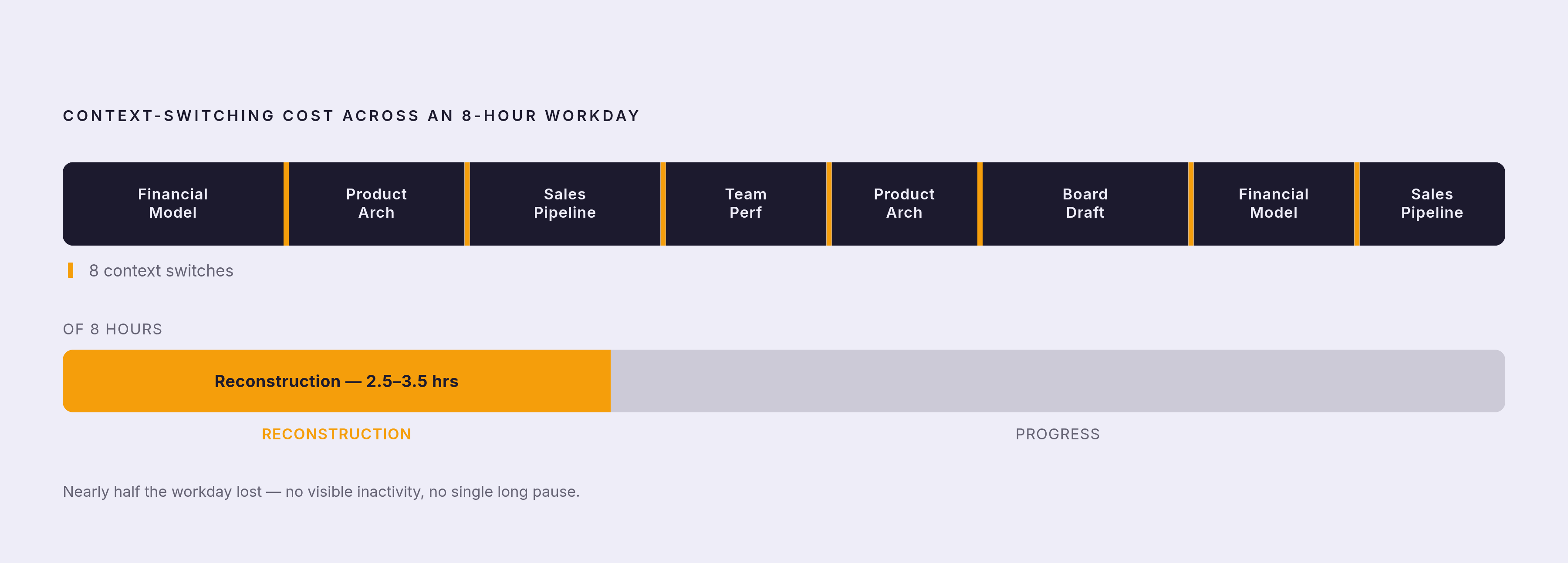
Consider a day involving five distinct mental models, including a financial model review, a product architecture conversation, a sales pipeline discussion, a team performance conversation, and a board update draft. Each asks the founder to reason differently. Switching among them eight times creates repeated reconstruction work, even if none of the individual activities feels wasteful.
An illustrative estimate puts that ramp-up at between 2.5 and 3.5 hours in an eight-hour workday. This illustrative estimate shows how much time several switches could take when the work is complex and takes a long time to pick up again. Nearly half a day can disappear without a single obvious period of inactivity.
Where does that time appear on the calendar? Usually, inside the work itself. Reviewing the financial model means remembering why an assumption changed, while drafting the board update means recalling the thinking behind a product decision. A time tracker records both as work, without distinguishing reconstruction from progress. If another switch arrives before that reconstruction is complete, the founder may leave with both little progress and a decision made from partial context.
The two structural forces that make founders' calendars a context-switching machine
Calendar fragmentation creates the first source of repeated resets. Founder calendars commonly contain three to seven meetings a day with little thematic coherence. An engineer’s 1:1 gives way to a sales call, followed by a product review and board preparation. Each meeting may be reasonable on its own. But the order of those meetings keeps pulling the founder into a different domain before there is time to think it through.
Writing assistants, meeting recorders, calendar optimizers, note-takers, and CRMs may each hold useful information without sharing it. A priority change in email may be invisible in the project management tool, while meeting notes may never inform the next day’s briefing. The founder becomes the connecting layer between systems. That means switching not only between business problems but also between the tools intended to help manage them.
These forces can make each other worse even when no one sets out to build a bad schedule. A meeting demands a domain reset, and the relevant information is then scattered across separate places. Knowing the cost of switching leaves both conditions in place. The schedule sets how often attention shifts, while the way the tools are set up helps decide how much context the founder must rebuild each time.
What founders can control without AI: calendar architecture and task clustering
Calendar architecture provides a practical starting point before any technology layer. Theme days assign a primary cognitive domain to each day and group related meetings and deep work around it. Jack Dorsey used this approach while running Twitter and Square simultaneously, with Mondays for management, Tuesdays for product, and Wednesdays for marketing, communications, and growth. The organizing unit was the mode of thought.
Shopify’s Tobi Lütke also uses day-theming and no-meeting Wednesdays to protect focused work and balance his calendar. Brian Chesky at Airbnb carved out long blocks of “narrative time” before major launches. These examples protect different kinds of thinking. Both set aside time for demanding work instead of leaving it to the time left over after other people’s requests.
For founders unable to redesign whole days, task clustering offers a smaller intervention. Founders can put investor emails in one block and product reviews in another to switch domains fewer times during the day. Keeping deep work windows of three to four hours free gives strategic work time to develop. Those windows need active defense against others’ scheduling convenience. Even then, calendar design reduces switching frequency but cannot remove the cost of re-entering a complex problem when an interruption occurs.
Where AI actually reduces the cognitive cost of re-entry
AI’s useful contribution at that point is context compression. A founder returning to product architecture after two hours of sales calls needs more than a transcript. They need to recover what was decided, what was deferred, what changed, and which questions remain open. Tools that maintain persistent context can surface that reconstruction in seconds rather than requiring the founder to assemble it manually.
Retrieval speed is not the same as understanding. A briefing can put the relevant pieces back in view, but the founder still has to evaluate their relationships and decide what follows. AI therefore reduces part of the ramp-up rather than guaranteeing instant readiness. Its value comes from shortening the route back to informed reasoning.
A founder moving among meetings benefits from briefings built from prior conversations and related email threads. A coding environment with repository-wide context helps a technical founder, while a founder moving between product and hiring needs to see past decisions in both domains. These serve different re-entry problems. A tool that retrieves one slice well does not necessarily preserve the whole business context.
For someone jumping between team chat, a shared workspace, a design tool, and email, the useful question is whether the assistant can preserve the relevant decisions across that workflow. Fluency alone does not answer it. The stronger fit is a system that reduces the founder’s reconstruction work, rather than requiring a fresh explanation every time the interface changes.
The real objection: AI as context-switch relocator, not eliminator
AI can introduce the very interruptions it promises to reduce. An agentic coding tool may handle boilerplate while the founder focuses on architecture. But reviewing its output requires leaving the original train of thought, loading the generated code’s context, checking correctness, and returning. The work has not simply vanished. Some of it has moved into a new review loop.
A collection of disconnected AI tools creates another version of the same problem. A writing assistant, meeting recorder, coding assistant, and search tool can each help with one task while forcing the founder to carry context from one to the next. Local speed does not establish a workflow gain. If the founder has to explain and review their outputs over and over, using the tools together can add to the cost of switching.
Dependency is a separate, serious concern. The 2025 MIT Media Lab EEG study by Kosmyna et al. found that LLM users had the weakest brain connectivity of the groups studied during writing, with cognitive activity falling as external tool use rose. The same study found higher neural engagement when participants worked independently before using AI than when they began with it. Within the writing tasks studied, the findings suggest that the order in which people think on their own and get help may matter.
A separate large-scale randomized experiment found that AI assistance improved immediate performance, but participants who later lost access performed worse and gave up more frequently than those who never used it. These findings challenge the assumption that easier assisted performance necessarily preserves independent capability. Founders should favor fewer, more deeply integrated tools and use AI to support reasoning already underway, rather than making it the automatic starting point for every thought.
What context-sharing architecture means in practice for a founder's AI stack
For founders choosing an AI stack, the asset to manage is context. Five to eight separate assistants may each know only one slice of the business. The relevant test is continuity. Can what was decided in Monday’s product meeting inform Friday’s investor update without the founder manually reconstructing the connection?
Pre-meeting briefings make that principle concrete by combining calendar history, email threads, and prior conversation notes. Their purpose is to restore the mental model before the meeting begins. Post-meeting capture should then route action items, owners, and decisions into the same context layer that produces the next briefing.
A persistent reasoning environment makes product architecture choices visible when the founder considers hiring for that product area. For technical work, repository-wide context reduces the need to leave the codebase and explain it again in an external chat interface. Each case removes a different reconstruction step. The buying criterion is integration depth at the points where the founder actually loses context.
What founders actually protect when they reduce context-switching costs
Protected attention makes room for decisions that require more than a quick answer. A founder can hold a strategic question long enough to notice a conflict, reconsider an assumption, or reach a non-obvious conclusion. That is a different benefit from clearing more tasks. The recovered time is valuable because of the cognitive state it makes possible.
Repeated switching can leave the founder depleted, making sustained engagement harder as the day wears on. A gap between calls is not necessarily usable time for a problem whose context has to be rebuilt before reasoning can begin.
The aim, then, is to protect deep context, sustained focus, and the bandwidth to notice both what is broken and what is urgent. The founder keeps responsibility for the thinking and uses structural advantages to protect the conditions in which that thinking is best.